_edited_.png)
_edited.png)


How Brock Leitner Came Back From a T6 Spinal Cord Injury to Become a PXG-Sponsored Adaptive Golfer

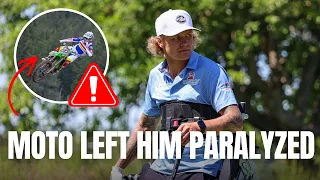
On June 12, 2022, Brock Leitner was racing the Canadian Motocross Nationals — round two of the triple-crown series — when he crashed. He was 24 years old, a professional motocross and supercross racer who had competed all over Canada and the US, and a four-handicap golfer who'd been playing seriously since his teens.
The day did not end the way he wanted it to.
He was knocked out for 50 seconds. When he came to, he could hear riders and medics around him saying "he's not moving, he's not moving." The first responders went through their tests. He couldn't move his legs. He couldn't wiggle his toes.
"I just finally looked up at the sky and started crying because I knew after doing certain tests that I was paralyzed."
His T6 and T7 vertebrae were shattered. His spinal cord was severely damaged. He is now a T6 paraplegic.
If the story ended there, you'd already understand why we wanted him on the show.
But it doesn't end there. Not even close.
The 4-handicap who'd already been playing golf one-handed for years
A 4-handicap takes a decade of work to build. It means you can shape shots both ways, control distance with your wedges, and read greens like the morning paper. Brock had built that game on Alberta courses, between motocross seasons, since he was a teenager. Pre-injury, he was carrying his driver 280 to 290 yards.
The accident took his lower body. It did not take his swing.
What most people don't know is that Brock had been playing one-handed long before the crash. Motocross had broken both his collarbones multiple times. Each time, he refused to put down the clubs — he just learned to play with one arm. He once played a full round on one leg after tearing his ACL, MCL, and meniscus on a single ride.
"I've always found ways to just want to golf — with any injury. So when this happened I was just like, it's a no-brainer. I love golf so much, and I'm not giving up this sport."
For the first 18 months after the accident, he played from his wheelchair. He bought a cheap set of old clubs off a driving range for around $100, took them to Golf Town, and had them bent until they broke and re-welded to the right lie angle for a seated swing. Two adaptive golfers down in California — David Bailey (a Motocross Hall of Famer) and Mike Young at Road to Recovery — had shown him the path: "Hey, we just golf in our wheelchairs." That was the first version of his adaptive game.
The moment in the GF Strong hallway
Brock's first rehabilitation stop after the crash was GF Strong in Vancouver, one of Canada's top spinal-cord injury rehab centers. He wasn't thinking about golf in those first weeks. He was thinking about getting his body to a baseline.
Then one day, rolling between physio sessions, he looked up.
"I looked up on the wall and I saw that they had this picture of someone golfing in a paragolfer. And I was like — hey, you can still golf."
That was the moment. He pulled out his phone, started googling, and found out what a ParaGolfer was. He also found out what it cost: roughly $40,000-$45,000 CAD for the newer equivalent (the model is now called the "Para Motion"). It's a price tag that should kill the project before it starts. For Brock it just stretched the timeline.
Why he flew to Mexico
For 18 months after the accident, Brock pursued every option the Canadian medical system offered. He made measurable progress. He needed more.
In May 2024, he flew to Guadalajara for a treatment combination still on the experimental edge in North America: epidural stimulation paired with stem cell therapy. Epidural stim places a small device along the spinal cord that delivers low-level electrical impulses below the injury site, in some cases reactivating neural pathways that have gone dormant. Stem cells go after the damaged tissue itself. Together, they form a protocol still being studied at research hospitals around the world.
What it gave Brock wasn't a Hollywood ending. It was something more useful.
"With that spinal cord stimulator, it's given me the ability to still use muscles in my legs and maintain muscle in my legs, in my core, in my back — like my lower back where I can't really work on those muscles."
He can sit in his chair and fire leg extensions. The muscle tone he was losing came back. His overall body health improved. He hasn't needed to return for remapping.
"The whole team there was just absolutely amazing. I can't say enough good about it."
The ParaGolfer changes the game
Standing in a controlled environment is one thing. Hitting a golf ball at competitive distance is another. The bridge between the two is the ParaGolfer — a stand-up mobility rig built specifically for the sport. It supports the user upright, lets them rotate at the trunk, and gives them a stable base to swing from. It's the closest thing the adaptive game has to an equalizer.
With the rig dialed in, Brock did what comes naturally to him: he played. Then he competed. He's now traveling the continent for adaptive tournaments in the US and Canada. He's also competed at the World Para Surfing Championships and played wheelchair basketball. Of the three, golf is the one he came back to — and he's specific about why.
"I don't care about any of those sports. That's not my passion. My passion's golf."
His one-handed swing works because his left hand stays locked into the ParaGolfer's handle. That gives him a leverage point most adaptive golfers don't have — and it's why he holds with his lead arm instead of swinging his stronger right hand alone. He can pull himself through the downswing, which fires what hip rotation he has access to. He can work the ball both ways from there. He carries his driver 150-160 yards in the air; with rollout, his total is 175-190.
The PXG call
Then came PXG.
PXG is one of the premium club brands in golf. Their roster includes PGA Tour pros and LPGA stars. They are not, historically, a company that sponsors adaptive athletes as a matter of course.
The conversation didn't start with PXG calling. It started with Brock calling them — looking for a flat enough lie angle his early adapted clubs couldn't deliver.
"That's when I first ever reached out to someone with PXG. I knew they do a lot of specialty work, so I was gonna see if they could make a club that's a flat enough lie for me."
What followed was a full PXG fitting (his fitter, Sheldon Slonski, dialed everything in) and a roster spot. The change in his game has been measurable:
"It's been such a game changer since linking up with PXG. I easily gained 10 to 15 yards per club. Last year if I needed to carry the ball 90 yards I was hitting a seven iron. Now I'm carrying my pitching wedge 90 yards. I barely pull my seven iron."
His current bag is built around the Gen 8 irons, the Lightning driver, the new mini driver, and the Sugar Daddy wedges. The yardage gain has changed how he plays the game itself — "this is how golf is supposed to be played at a certain level. Driver-iron into a green, not driver-7-wood."
What every weekend golfer can learn from him
If you came to this story expecting an inspirational tale about "never giving up," you've underestimated what Brock has to teach.
The most useful parts of this episode for the average weekend golfer have nothing to do with disability. They have to do with the swing, the body, and the head:
Where power actually comes from. When you can't drive a swing from your legs, you learn very fast where the leverage has to live. Brock's framework — leverage from the lead arm into the ParaGolfer handle, trunk rotation that's available, hips that move that much — is the kind of mechanical clarity tour coaches charge real money for. It applies directly to any amateur over 35 whose lower body isn't producing the speed it used to.
Equipment that actually matters. Brock can describe in concrete numbers what the right fit does to a player's game — club length (he plays a half inch shorter than men's standard), lie angle, head and shaft combinations, and what each one moves on the launch monitor. The next time someone tells you a fitting isn't worth it, listen to the 10-15 yards per club he picked up by getting one.
The mental game without the platitudes. When the host asked Brock what he'd say to a 17-year-old who had just had a life-changing accident, this is what he said:
"Mindset. That's the biggest thing. You can say 'poor me' all you want, but at the end of the day this is what life is giving you. It sucks, sure. Some days it's shitty. But you know what — you're still living. You still got family. People to love you. Try and make the best out of every day. Everyone has bad days. It's how you overcome them. You're gonna adapt. You're gonna overcome all the stuff that's hard, and it's gonna become easier every day you do it."
And when he was asked for his closing piece of advice for the next generation of athletes:
"Don't take things for granted. Give it your all — 110% effort every time. Do it for a purpose. If you're not loving what you're doing, don't do it. Go out there and be the best you can every day, and take the good with the bad."
Listen to the full conversation
This is a conversation that earned its place on the show. Brock is one of the harder people we've had on — physically, mentally, philosophically — and one of the most coachable, curious, and engaged guests in 283 episodes.
🎧 Listen to the full episode now: Apple Podcasts · Spotify · YouTube · Buzzsprout
Follow Brock: @brockeitner on Instagram Learn about PXG: pxg.com
More from The Athletes Podcast
We've spent six years and 283 episodes asking pro athletes, Olympic medalists, coaches, and sports scientists what regular people who actually train can learn from them.
👉 Get the free guide: The Top 25 Pieces of Training Advice From 283 Pro Athletes. One short PDF. Six years of conversations. Download here.
👉 Get the weekly newsletter. Every Friday, a 5-minute recap of the week's episode with the actual takeaways for your training. Subscribe.
👉 Run with us. Our weekly run club meets every Sunday at 9 am at George Wainborn Park. Strangers when you arrive, friends when you leave. Join.
The Athletes Podcast is hosted by David Stark. New episodes every week.
Comments