_edited_.png)
_edited.png)


From Overtraining to the Sparta Score: How Cole Hergott Turned an 1,100 Sq Ft Weight Room Into the Engine of a National Powerhouse

Listen now
Apple · Spotify · YouTube
The line Cole Hergott opens the episode with is the line that defines his whole coaching philosophy:
"Our today's do not ruin our tomorrow's."
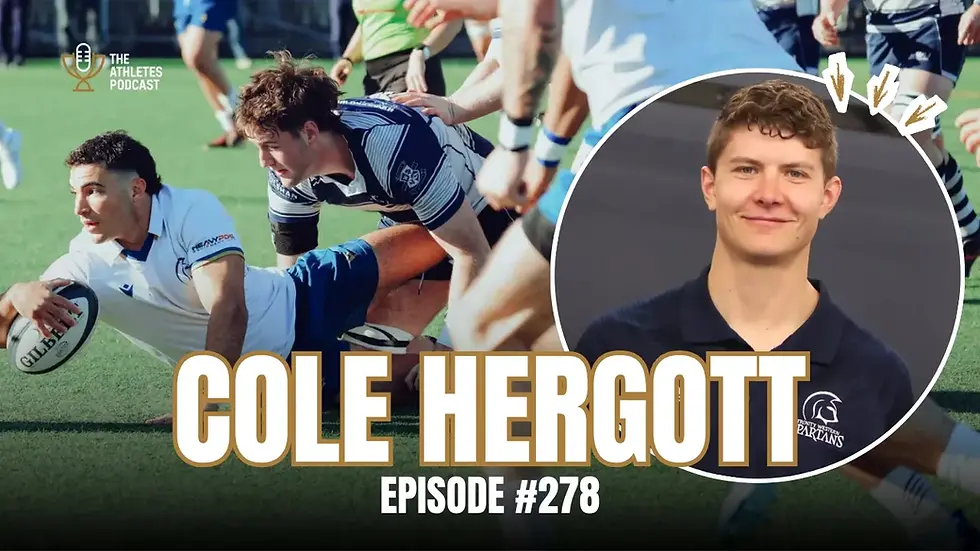
Cole is the head strength & conditioning coach at Trinity Western University. He manages 14 varsity sports and 300+ athletes out of an 1,100 sq ft weight room he calls Sparta. He came to the job as a Saskatchewan kid who chased junior hockey out west, played two games as a freshman defenseman, sat as a healthy scratch most of the year, and decided in his exit meeting with the head coach that the weight room was where he actually belonged.
Six and a half years into the job, he's done something genuinely useful: he's built a single number that tells every athlete, every coach, and every redshirt how they're trending — and turned the logistics of a small weight room into the engine of the system.
That number is the Sparta Score. This is the story of how he built it, and the training philosophy underneath it that every weekend athlete can steal.
The constraint that built the system
Cole's weight room is 1,100 sq ft — basically a converted classroom. The gymnasium next door is open for warmups and sprints, but it's almost always occupied by another sport. The upstairs fitness studio is too slick for sprints and jumps. The result, for years, was a steady leak of data:
"We were testing women's soccer — 30 girls on the team — and some couldn't make team lift times, the gym wasn't available at other times, and I only ended up getting like 10 of the girls' sprint times. The coach doesn't really care what 33% of their team is doing."
So instead of building a better facility, Cole built a better test — one that could be run entirely inside the four walls of Sparta, on any athlete, on any day, in any season.
The Sparta Score, explained
The Sparta Score is one number per athlete that combines five sub-max tests, all conducted in the weight room:
3-meter sprint (forced down from 20m because there's no room — they sprint corner to corner)
Counter-movement vertical jump on force plates
Squat speed at a fixed weight, measured with a velocity-based training (VBT) unit on the bar (males: 135 lb back squat; females: 95 lb)
Bench speed at a fixed weight (males: 135 lb; females: 75 lb)
Chin-up speed at bodyweight (with a bungee assist where needed)
The formula:
Sparta Score = squat speed + bench speed + chin-up speed + jump height − sprint time
The sprint subtracts because faster = lower time. The rest add because faster = stronger.
The insight that makes it work isn't the math. It's the fixed weight. When you test every athlete at 135 lb back squat regardless of their max, the only thing that changes between athletes is how fast the bar moves. A 200-lb squatter moves 135 fast. A 135-lb squatter moves it slow. As the 135-lb squatter gets stronger over the season, the same 135 lb starts moving faster — and the Sparta Score climbs.
"If your Sparta score is higher than someone else's, you are physically better than they are. If your Sparta score is getting better — end of story — you are getting better."
Why this is genuinely better than what most programs do
Cole was inspired by the Nebraska Huskers' aggregate score under Boyd Epley — widely considered the first true university S&C coach. He talked to Boyd directly about the original system. Nebraska's version was more complex and required full one-rep-max testing.
Cole's variant fixes the things one-rep-max testing breaks for in-season athletes:
It's sub-max — you can test the day before a game with no recovery cost
It's safe — a 135 lb squat speed test is not going to injure your starting goalie
It's repeatable — you can re-test the same athlete every 4-6 weeks
It's a single number — coaches don't have to interpret five spreadsheets to know if an athlete is trending up or down
It works across sports — a women's volleyball player and a men's hockey defenseman can both produce a Sparta Score and compare it apples-to-apples
The unintended cultural side-effect has been even better than the data:
"It's become a huge flex. A common phrase is, 'what's your Sparta score?' So now no one's like, 'hey, what do you bench?' It's, 'what's your Sparta score?'"
The current leader gets a physical keychain. There's a top-20 leaderboard. The men's volleyball captain and the men's rugby captain have been trading the lead all year. The leaderboard record (4.61) belongs to Tim Zimmer on the rugby side — a guy who back-squats 500-600 lbs, benches 400, and treats 135 lb like a warm-up. The women's record belongs to Kaylee Plough, a volleyball player Cole called "beast of all beasts." And the men's hockey goalies hold the records for the 3-meter sprint AND the team record for the jump.
"Goalies are freaks. Can confirm."
The real lesson: it's not overtraining, it's under-recovery
The other half of the episode is Cole's coaching philosophy, and it's worth listening to on its own. He's open about the fact that as an athlete, he was the "more is better" guy who outworked his recovery and never got the gains he should have.
"I was that athlete that was more is better. So I lived the overtraining and doing too much and doing the wrong stuff and not having a coach to kind of guide me."
The framework he uses with his athletes now is simple:
"A lot of overtraining — it's not even overtraining. It's just under-recovery. The human body has to work extremely hard to be in a state of true overtraining. But a lot of that just comes from, well, you only slept five hours last night. You didn't stretch after. You didn't eat enough protein. If you've got 800 calories — it's not overtraining, it's underfueling."
The corollary, for any weekend athlete who lifts: if you're tired, sore, and stagnating, the answer isn't almost ever "do less training." It's "do recovery better." Sleep, protein, hydration, mobility. Cole says the moment you get those right, "the sports performance and gains just flow like milk and honey."
Why he'd rather you train more often than train harder
This is the section that will rearrange how a lot of weekend lifters program their week.
"Why would you smash your legs on Friday, be wrecked Saturday, can start to walk on Monday, only to smash it again on Friday? Why would you not do a little bit every single day?"
Cole's preferred structure is full-body programs three to four times a week. Same total weekly volume as a traditional bro-split, but distributed across more days at lower intensity per session. He cites Mind Pump's full-body advocacy and the underlying principle of the farmers who threw bales of hay every day and ended up some of the strongest people on earth.
The simpler version: "more is not better. Better is better."
If you're training hard but not improving, you're not training. You're just being tired.
Individual-specific, not sport-specific
When he programs for 14 different teams, the temptation is to build 14 distinct sport-specific programs. He resists it.
"It's almost like individual-specific, not sport-specific. I'm not necessarily programming for a men's hockey team. I'm programming for our men's hockey team."
The foundation is universal: squat, hinge, push, pull. The variations come from the athletes in front of him:
Men's volleyball — front squats for the vertical jump emphasis, plus Olympic lifts because the guys want them (buy-in matters more than theoretical optimization)
Men's hockey — back squats for horizontal force projection, lighter on Olympic lifts because of common wrist issues
Women's volleyball — finger push-ups for setting strength, plus isometric neck work after a wave of concussions
Rugby — neck work, full Rugby Canada one-rep-max testing for athletes being scouted for national programs
Cross-country — force plate testing focused on left/right asymmetries
The principle underneath all of it: "I'm gonna make you a bigger, faster, stronger athlete. You decide what athlete you become with that."
Isometrics and the 24-hour potentiation window
Cole uses overcoming isometrics — pushing or pulling against a bar that won't move — for the athletes his force-plate data flags as force-deficient (jumping high but not fast). The pitch he gives his rugby team on game day is one of the cleanest framings of game-day potentiation training you'll hear:
"If you do this hard enough, you can benefit from the potentiation effect of heavy lifting for 24 to 48 hours. Guess what's within 24 to 48 hours? They all go: our game. I go: awesome. If you slack off and you just kind of go through the motions, the effect lasts about six hours. Guess what's not within six hours? Our game."
For rotational athletes — hockey, throws — he rigs the bar to simulate a shot or a throw motion and has them push as hard as they can without movement. Then he hands them a 10-lb medicine ball and they whip it through space.
"They whip it harder than they've ever whipped it in their life because they're so fired up, potentiated from 'I'm not moving,' and then you grab a med ball and it's like wham."
On confidence: build it like a bank account
The most underrated minute of the episode is when Cole references his mentor Johnny Parker on belief:
"Make them feel special and believe in them. If an athlete comes to you and says 'I want to get faster' and they're slow as hell, my job is not to go, 'nah.' My job is to go, 'absolutely, let's get after it.'"
The Sparta Score, for him, is a place where redshirts and bench-warmers can post real, public, measurable wins — and start building self-efficacy.
"Self-efficacy — that confidence — you can build it like money in your bank account. So when you get to those scary moments of 'oh shoot, I did get picked to take the penalty shot,' it's like — I know I can do this. I was successful in my Sparta score in the weight room. That carries over."
This is the part of the conversation that connects S&C work back to actual game performance — and the part that makes Cole's job something other than just "running the gym."
The closing line: optimal, not ideal
The standing closer on every Athletes Podcast episode is the biggest piece of advice for the next generation of athletes. Cole's version is the line that goes on the gym wall:
"Always work with what's optimal, not ideal. We have this ideal in our heads of how things should be — I'm in an 1,100 sq ft old classroom for a weight room and I need to develop national champions. But it's not about the Oregon Ducks weight room we've all seen. It's about what I have. How can I optimize what we have? Same thing as an athlete — I'm not playing this weekend? That's not ideal. But I'm gonna optimize my situation by getting in an extra run, watching more game film. When the opportunity comes, the optimum becomes your ideal."
That's the whole show in one paragraph.
What weekend lifters and athletes can steal from this episode
The four things to take to your next training block:
1. Test the same lift at the same weight every 6 weeks. Forget chasing PRs. Pick a sub-max weight you can do safely, record the bar speed (your phone in slow-mo works if you don't have a VBT unit), and watch how the same weight moves faster as you get stronger. That's Cole's whole insight — and it scales down to any home gym.
2. Train full-body 3-4 times a week instead of bro-splitting. Hit the same muscles more often at lower per-session volume. Cole's logic — better is better, not more is better — works at every level of athlete.
3. If you're tired, recover better. If you're plateaued, eat more protein. "It's not overtraining, it's underfueling" is the line you needed to hear five years ago.
Listen to the full conversation
If you've been listening through our recent strength-and-performance arc — Dr. Dan Braun on the phase 3-4 rehab gap (#282), Brandon Pentheny on NBA performance (#276) — Cole's episode slots cleanly between them as the "this is what real college-level S&C looks like" middle ground.
🎧 Listen to the full episode now: Apple Podcasts · Spotify · YouTube · Buzzsprout
Follow Cole and Trinity Western Spartans S&C:
Cole Hergott on Instagram (confirm handle in show notes)
Trinity Western University Spartans — twuspartans.ca
Mentioned in this episode:
Boyd Epley — Nebraska Huskers, original university S&C coach
Andrew Hemming, Andrew Evans — Cole's TWU mentors
Johnny Parker — Cole's mentor on belief
Dave Scott McDowell (DSM Strength, Brock University) — built the Google Sheets dashboards Cole uses
Apex Cool Labs (Ariel and Evy) — the cooling palm products David mentions
Brad Thorpe / ISOFit — referenced for isometric training
Perfect Sports Supplements — episode sponsor
More from The Athletes Podcast
We've spent six years and 284 episodes asking pro athletes, Olympians, coaches, and sports scientists what regular people who train can learn from them.
👉 Get the free guide: The Top 25 Pieces of Training Advice From 284 Pro Athletes. One short PDF. Six years of conversations. Download here.
👉 Get the weekly newsletter. Every Friday, a 5-minute recap of the week's episode with the actual takeaways for your training. Subscribe.
👉 Run with us. Our weekly run club meets every Sunday morning in downtown Vancouver. Strangers when you arrive, friends when you leave. Join.
The Athletes Podcast is hosted by David Stark. New episodes every week. Recent strength-and-performance episodes you might also like: Dr. Dan Braun #282 on the phase 3-4 rehab gap, and Brandon Pentheny #276 on NBA performance behind the scenes.
Comments