_edited_.png)
_edited.png)



Inside Performance Science With the Lakers' S&C Coach: Dr. Brandon Pentheny on Capacity vs. Utilization, the Data That Actually Matters, and Why LeBron Is the Outlier You Shouldn't Copy

Listen now
Apple · Spotify · YouTube

There's a thing every fitness podcast and every Instagram fitness account does that, by Brandon Pentheny's reckoning, slowly poisons the development of every athlete who isn't a generational outlier:
"If you look at any data points for any athletes, like — he's the outlier. You can't relate that guy to the rest of this group. It doesn't fit the generalizable trend."
He's talking about LeBron James, who he works with at the Los Angeles Lakers. He could just as easily be talking about Tom Brady, or Scotty Scheffler's 140-week streak at world #1, or Ken Griffey Jr.'s career, or any other anomaly your social feed is selling you the playbook for.
"You can't apply Tom Brady's longevity to this — to these athletes. The miserable Ken Griffey's an outlier-type players — you can't apply that to the rest of our guys. That's unfair to the development group for any sport."
The rest of this episode is what to look at instead. It's the most concentrated 35 minutes of "how an actual pro performance scientist makes decisions" we've published on this show.
Who Brandon is
Dr. Brandon Pentheny holds a PhD plus a stack of the highest credentials in his field — RSCC, CSCS, CPSS. He's currently the strength and conditioning coach for the Los Angeles Lakers. Before that, he was at the Washington Nationals in MLB. He played a wide range of sports growing up, won a state championship in weightlifting, was a practice player for basketball at the University of Oregon, and made a real run at the Olympics on the bobsled side — "if you could've told me I could play ping pong in the Olympics, I would have tried that."
That breadth — both as an athlete and across pro sports as a practitioner — is what makes him an unusually clean translator between the lab side of performance and the locker-room side.
The two fundamental truths
Asked what he'd tell a high school coach with no force plates and no 1080 sprint machine, Brandon distilled it to two things:
"Two of the fundamental truths are training with consistency being one, and training with intent on any given task — whether that's skill-based or in the weight room. If you put out high intent consistently, you're headed in the right direction."
Consistency. Intent. That's the whole framework. Every other piece of equipment, every other metric, every other supplement is downstream of those two.
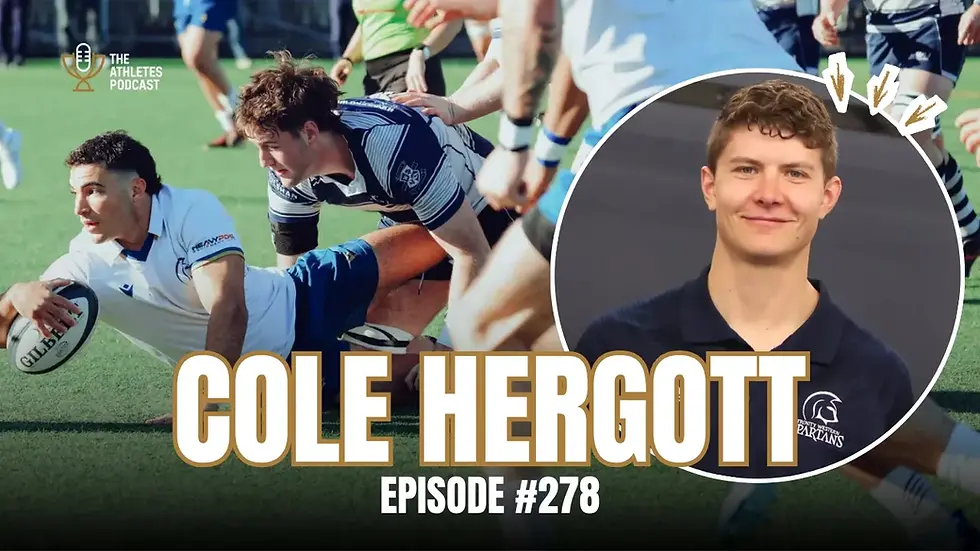
This is also worth reading next to the Dan Braun (#282) framework and the Cole Hergott (#278) Sparta Score — three pros from three different organizational contexts, all arriving at the same conclusion about what actually moves the needle at the foundational level. The framework converges. The execution differs.
Capacity vs. Utilization — the most useful framework in the episode
This is the section to take to your next coaches' meeting. It's an instantly usable mental model.
Every time a head coach watches an athlete struggle and says "he can't move laterally," Brandon's job is to figure out which of two things is happening:
Capacity — the athlete physically lacks the strength, speed, or dynamic stability to perform the task. This is an S&C problem. It's solved in the weight room.
Utilization — the athlete has the physical capacity (the metrics confirm it), but they're slow because their read is delayed or their decision-making is indecisive. That's a skill problem. It's solved in film, in practice reps, in sport-coach conversations.
"Strength and speed and dynamic stability is there. It meets all the metrics of where everyone else stands in the league. But they're slow because they're making delayed reads or they're indecisive. That's a utilization problem."
The reason this framework matters: applying the wrong fix makes the problem worse. If you make a utilization-limited athlete lift harder, you exhaust them without fixing the read. If you make a capacity-limited athlete watch more film, you give them better reads they still can't physically execute. The S&C coach who can name which one you're dealing with — and communicate it to the head coach — is doing the actual job.
Discrete vs. open skill sports
The other coach-communication insight that keeps coming up in Brandon's day-to-day:
"Baseball is very technical-based — hitting is a discrete task, a relatively closed source. Basketball is relatively open source in terms of how it flows, but you're still getting to a discrete task — shooting. You're funneling it down to a discrete task."
The practical consequence: baseball coaches generally already understand discrete-task data because the sport rewards it (one pitch, one swing, one outcome). Basketball coaches need the data carried through more layers — the "three or four steps down the line" — to see how a force-plate metric actually connects to what's happening in a flowing offense.
The S&C coach's job in basketball isn't just to collect the data. It's to bridge it across those three or four layers in a way the head coach can act on.
The high-school coach trap (and what lifting actually is for athletes)
This is the section to forward to any coach in your life who's still telling 16-year-olds to skip the weight room before practice.
"Part of the issue for some of those coaches is their frame of reference. What lifting is to them should be vastly different than what lifting is for an athlete. Lifting for athletes isn't, 'I'm trying to get a beach body, I'm trying to look big and lose weight,' whereas a lot of coaching staffs tend to shift that way."
"We're not doing sets to failure. We're not doing tricep dips and side bends and all this stuff like you see at 24-Hour Fitness. The frame — what you're trying to accomplish — is a little different. So you have my professional backing on that one."
Brandon's call: lifting before practice and games is standard in MLB and NBA. Same in the NFL. It works at the high school level too — the only adjustment is dialing the load exposure so it matches the athlete's recovery capacity.
Pre-practice CNS priming, in his own words, can look like:
Overcoming isometrics into a trap bar against a rack (push hard, nothing moves) for a set time
Followed by something extremely ballistic — double box jump, med ball vertical toss, anything explosive
Or — overloaded squat or row at short volume with fast concentric, controlled eccentric
Post-practice and post-game, he leans on tendon loading and isometrics for both baseball and basketball populations. "Anywhere you have a tendon that gets a lot of use can be effective."
If you're a weekend athlete who lifts — that's the same logic you can run for yourself. Light, intent-driven activation before the game. Tendon work after.
The Tommy John uptick and the MLB dead period
A part of the episode that should be required listening for parents of young pitchers — and for any youth coach watching the year-round-sport trend continue:
"In baseball over the last 15 years or so, a lot of athletes are going basically balls to the wall — especially pitchers — balls to the wall year-round. And they're chasing Velo in November. That's not a thing you should really be chasing in November."
The MLB's response — built into the league's schedule — is a dead period roughly from Thanksgiving to New Year, during which teams can't contact most players for baseball-related work. Recently, the league extended the rule to include no scouting during that period. Brandon's hope is that the scouting restriction trickles down and forces high school and travel-ball programs to give young athletes the same kind of structured off-season the pros now get.
Tommy John surgeries among high school pitchers have climbed dramatically over the past 15-20 years, and Brandon connects the dots directly: kids are training, throwing, and chasing velocity in months they should be recovering.
The same logic applies to youth hockey in Canada. Same logic applies to year-round soccer. Same logic applies to AAU basketball. An athlete who never has a down period never adapts. Adaptation is a recovery phenomenon.
What coaches get wrong when they present data
This is the section that will land hardest with anyone in the S&C / sport-science world specifically — but it's worth listening to even if you're an athlete who's been on the receiving end of "the data says you need to..." speeches.
"In terms of like sports science practitioners making the mistake — they don't convey adequate information with the ability that it's information and then not purely decision. It's driving the decision. But the bigger one — can you have normal conversations with this person about things that don't relate to work? If you can do that and actually give a shit about your conversations that don't relate to work — that's a huge one."
The deeper craft Brandon describes is deductive reasoning made visible. A force plate gives you a metric. The metric on its own means nothing to the head coach. The S&C coach's job is to translate it into a question like:
"This player makes his money being springy. We need to look at his P1-to-P2 contact-time impulse ratio. If we can keep him in this range physically, we give him the best chance to develop his greatest accelerating factor."
That's a sentence a head coach can act on. The same metric, without that translation, is noise.
"We're trying to do deductive reasoning to make this athlete better. What are their greatest limiting factors? What are their greatest accelerating factors? Let's identify those, convey that with adequate visual appeal, can somebody contextualize and verbalize that correctly? Then can we make tangible changes in the weight room, on the court, in skill development?"
That paragraph is the job. Everything else is the costume.
When the literature fights the athlete (and the ethics of "fly close to the sun")
The most thought-provoking moment in the episode is when Brandon talks about times the published research disagrees with the athlete in front of you.
Example one — modified reactive strength index (the "bounciness" metric). The literature says elite athletes should hit ~0.8. But:
"Not everyone has to have a modified reactive strength index of 0.8. Sometimes guys are more skill-driven — that's what got them to the league. It's nice, I can chase that. It might be a byproduct of doing something else. But that's not where I'm gonna throw all my attention. If we try to chase that, we might screw them up."
Example two — pitching arm slot in baseball. Published research often says a certain arm slot is healthier. But:
"You move that player to that arm slot, you might completely change who they were as a pitcher. They might not make any money. They might be out of the league and cut. You dance with ethics. This athlete kind of knows this isn't the most healthy arm slot, but that's the only thing that makes them them. You might fly close to the sun and slingshot around. Or you might burn."
This is the part of the conversation that separates a practitioner with a PhD from a practitioner reading the latest paper. The PhD knows when the paper applies, when it doesn't, and what the cost of misapplying it would be to the athlete's career.
The closing line: be the impression of your sixth-grade self
The standing closer on every Athletes Podcast episode is biggest piece of advice for the next generation of athletes. Brandon's version landed unexpectedly heavy:
"Try to be the impression — your sixth-grade self. We're all 15 minutes away from being irrelevant. So try to be a good person."
Coming from a guy at the top of one of the most visible jobs in pro sports — paired earlier in the same episode with his advice for young coaches ("don't get too big no matter who you work with or who writes your paychecks") — that's a paragraph that should go on a poster.
David also closed the episode with an Ernest Hemingway line from The Sun Also Rises that Brandon nodded at:
"I can't stand it to think my life is going so fast and I'm not really living it."
Two writers, one S&C coach, one host, and a quiet reminder that the technical work only matters if the person doing it stays a person.
What every weekend lifter can take from this episode
1. Stop copying outliers. Whatever LeBron does for his body has been refined for 22 years in a body that is not yours. Same for Brady. Same for Scheffler. The framework you should be running is the consistency-plus-intent baseline that applies to literally every athlete in the league average.
2. Diagnose capacity vs. utilization in your own training. If you can't do something — is it because your body isn't capable, or because you don't know how? Don't fix the wrong problem.
3. Lift before you play. It's standard at the pro level. It works at every level below it. The dosage gets lighter, the intent stays the same.
4. Take a real off-season. A month of structured de-load is what allows the next training block to actually produce adaptation. Pitchers, hockey players, AAU basketball kids — the rule applies the same.
Listen to the full conversation
If you've been working your way through the recent strength-and-performance arc on the show — Dr. Dan Braun #282 on the phase 3-4 rehab gap, and Cole Hergott #278 on the Sparta Score — Brandon's episode is the third leg of the same triangle. Three pros, three contexts, one consistent core message about what actually matters in athletic development.
🎧 Listen to the full episode now: Apple Podcasts · Spotify · YouTube · Buzzsprout
Follow Brandon and the Lakers performance team:
Brandon's Instagram
Los Angeles Lakers — nba.com/lakers
Mentioned in this episode:
The Washington Nationals (Brandon's prior MLB role)
University of Oregon basketball (Brandon was a practice player)
Brad Thorpe / ISOFit (David's isometric setup, referenced re tendon loading)
Zach Zillner — previous show guest, referenced on the lifting-before-practice topic
Jordan Shallow — referenced for the "play the man" framework
Mitchell Hooper — World's Strongest Man, referenced as a multi-sport-capacity example
Ernest Hemingway, The Sun Also Rises — David's closing quote
More from The Athletes Podcast
We've spent six years and 284+ episodes asking pro athletes, Olympians, coaches, and sports scientists what regular people who train can learn from them.
👉 Get the free guide: The Top 25 Pieces of Training Advice From 284 Pro Athletes. One short PDF. Six years of conversations. Download here.
👉 Get the weekly newsletter. Every Friday, a 5-minute recap of the week's episode with the actual takeaways for your training. Subscribe.
👉 Run with us. Our weekly run club meets every Sunday morning in downtown Vancouver. Strangers when you arrive, friends when you leave. Join.
The Athletes Podcast is hosted by David Stark. New episodes every week. This episode is part of a three-episode strength-and-performance series — see also Dr. Dan Braun (#282) and Cole Hergott (#278).

Comments