_edited_.png)
_edited.png)



The Secret of Athleticism: Chong Xie on Fascia, the Foot-to-Glutes Connection, and Why Elite Athletes Don't Need Big Muscles

Listen now
🎧 The Athletes Podcast — Episode 276: Chong Xie
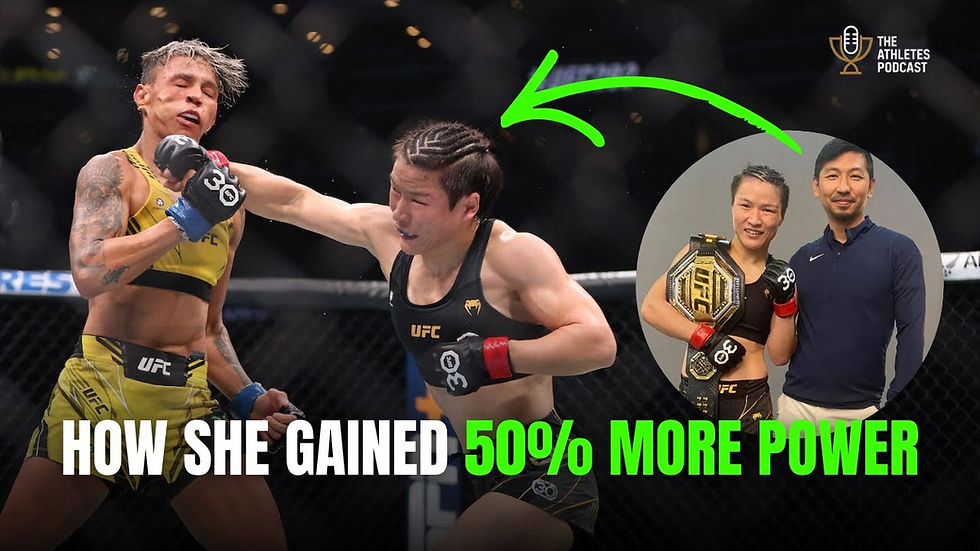
Four months. 50 to 60 percent more punching power.
That's the measurable change Chong Xie's Hyperarch Fascia Training (HFT) produced in a then-future UFC strawweight champion before she fought the reigning ex-champion. They measured it on a device that quantifies punch pressure. The number wasn't a feeling. It was data.
"Our biggest goal was to make her more fascia-driven. Increase her punching power, because the majority of punching power comes from the glutes."
That sentence — the majority of punching power comes from the glutes — is the single line that introduces what Chong has spent the last several years arguing. Athleticism doesn't come from muscle mass. It comes from a connective-tissue network that mainstream strength training, in his view, has been ignoring for decades.
This is the most contrarian episode in our recent strength-and-performance run. After Dr. Dan Braun (#282), Cole Hergott (#278), and Dr. Brandon Pentheny (#277) — three pros all working largely inside the conventional muscle-first model — Chong is the voice asking whether the framework itself is wrong.
This is the case he made on the show.
Who Dr. Chong Xie is
Chong Xie is the founder of Hyperarch Fascia Training & Therapy (HFT). He's a clinical fascia researcher who has done dissection work at Stanford and trains professional athletes across MLS, NFL, and NBA rosters. He was the performance coach behind the four-month prep for Zhang Weili's UFC strawweight title fight. He's worked with Danish footballer Pione Sisto on chronic Achilles issues. His Instagram following includes Olympic javelin thrower Liz Gleadle, World's Strongest Man Mitchell Hooper, and eight-time Mr. Olympia Phil Heath — a deliberately broad cross-section that includes athletes whose physiques look nothing alike.
His self-description is "the 1% man who reverse-engineered what the best in the world have in common physically." Instead of studying what average athletes do and trying to improve it, he studied what's unique to elite naturals — and built the training around that.
The 20% the mechanic threw away
The cleanest analogy of the episode:
"Imagine you take your car to a mechanic, and the mechanic says, 'I took apart your car, but I don't know what that 20% does. I'm gonna put it back together and make sure your car runs well.' Would you trust that answer?"
The 20% is fascia. A water-based collagen tissue, gel-like, that integrates everything across the body. Roughly 17 to 22 kilograms of it in the average adult. It accounts for about 20% of body composition.
For most of the history of S&C science — and most of the history of medical training — fascia was thrown out during dissection. Cadavers were stripped of it before the muscles were studied, because nobody knew what it did and it got in the way of seeing the structures the curriculum cared about.
Chong's argument is that without including fascia in the model, the model can't actually describe how elite athletes move. The strength coaches aren't wrong about muscle. They're working with an incomplete picture.
"The understanding of muscle is correct. But because there is a fascial component that was missed during dissection — and we didn't know what the fascial component does in conjunction with the muscle — we didn't understand how the athlete is built. So we were just focused on, 'let me build more muscle cells, more type-II muscle fibers,' but ignoring how elite athletes are actually developed."
The foot-to-glutes connection (the centerpiece insight)
If you take one thing from this episode, take this. It's the part of his argument that's most directly testable on yourself.
"Elite-level athletes actually have a very high level of foot-to-glutes connection. And this is not present in average athletes or everyday people."
Anatomy textbooks show the fascia lata (the major fascial sheath on the outside of the thigh) inserting into the IT band and continuing downward. Chong's contention, based on dissection: 80% of the fascia lata actually inserts into the glutes. The textbook image — which most coaches and most physios still learn from — captures roughly the bottom 20% of the structure and misses the upper integration entirely.
What that means in practice: there's a continuous fascial pathway from the plantar fascia in the arch of the foot, through the anterior tibialis tendon (the prominent tendon in the front of the ankle), up through the leg, to the glutes. When that pathway is intact, force generated at the ground gets transmitted directly to the hips.
When it's not — and Chong claims this is the default state for non-elite athletes — the body becomes segmented. Force gets generated at the foot, dissipates through the calf and quad, and arrives at the hip diminished.
The EMG evidence Chong cites for this comes from work done with Athos (the smart-compression startup that closed down, formerly funded with $20-40M to build full-body surface EMG suits). When elite athletes walk, EMG shows big glute activation. When non-elite athletes do the same walk, EMG shows quad and hamstring activation — the glute signal isn't there.
"Even when the average athlete could have bigger muscles than the elite-level athlete, or even lifted more concentric-wise — when they're on the field, they can't compete."
The training implication: making the foot-to-glutes pathway functional is, in Chong's framework, a higher-leverage move than adding mass to the legs.
The Stanford dissection moment
The most physically demonstrable evidence Chong offered:
"When we do dissection — which I did at Stanford — we can just pull the fascia from the glutes, and the entire leg will move."
That's not muscle moving the leg. That's the fascial sheath transmitting force from one end of the body to the other. If the dissection observation holds at scale (and it's worth flagging that this is the part where you want to read the research literature before treating it as settled), it's the single most direct evidence for the integration he's describing.
How fascia actually changes (it's molecular, not mechanical)
The skeptic's question — "you can't change tissue that tough with bodyweight movements" — has a specific answer in Chong's model. You're not trying to stretch fascia mechanically. You're triggering cellular regeneration.
"Your fascia has tensile strength 552 times stronger than muscle fiber — 276 megapascals. The muscle without the fascia is 0.5. So that's the enormous amount of tensile strength. You cannot influence the fascia with brute force. But you influence it from a molecular, cellular level, gradually."
The mechanism, as Chong describes it: stimulating receptors in the plantar fascia → triggering new fibroblast and myofibroblast cells → which produce fibroblast growth factors 1 and 2 → which gradually remodel the fascial matrix.
Timeline: three months for visible, measurable changes. Required inputs: hydration, vitamin C, collagen, a regulated nervous system. If the vagus nerve is impinged or the nervous system is dysregulated, progress stalls because tissue recovery stalls.
The "calf doesn't grow back after Achilles surgery" example sharpens the point:
"You can do gazillion calf raises for 10 years. It doesn't grow back. It's not a matter of just fatiguing and exercising the muscle. You have to restore the fascial connection. Once we restore that, we get the calf back."
If you've ever known an athlete who tore an Achilles, had the surgery, did everything the PT prescribed, and was left with a permanently atrophied calf — Chong's framework offers an explanation the standard rehab protocol doesn't.
Where this fights with mainstream S&C
This is the part of the episode that should provoke the people doing the work in Dan Braun's, Cole Hergott's, and Brandon Pentheny's worlds. Chong isn't subtle about it.
On the heavy-squatting-builds-explosiveness assumption:
"What you can lift in a slow manner does not equate to on-court strength or on-field performance. Without fascial integration, you can compensate to lift 300, 400 pounds. But that doesn't mean your fascia is working holistically when there's a speed factor or a fatigue factor."
On adding muscle as the path to power:
"Look at how elite athletes developed since childhood. LeBron James, Kevin Durant, Allen Iverson, Ja Morant, Messi, Ronaldinho — these people, when they were developing, didn't have big muscles. So the question we should be asking ourselves is, how do you get that athleticism — the balance, the coordination, the power, the vertical, the explosive power — without big muscle mass?"
On the result Chong's seen in his own work:
"Some people, in five weeks, get up to 50% more strength gain on a leg press test — just from working on the foot-to-glutes neurofascial connection. They didn't gain more muscle. They activated more of the fascial pull. Eighty percent of the fascia lata inserts into the glutes. That's tremendous."
For anyone who's been told for years that strength gain must come from progressive overload on a barbell, those numbers — if reproducible — change the calculus.
The fascial gliding piece (and why your old injury still hurts)
The other concept worth taking home: fascia has to glide.
"A lot of the chronic pain people have is because the fascia doesn't glide. It's stuck."
There are multiple layers — superficial fascia, deep fascia, visceral fascia. Each has to slide relative to the others for the body to transmit force efficiently. Old injuries, bad recovery, and disorganized scar tissue all create adhesions that limit gliding. When gliding is limited, force transmission suffers upstream of the stuck spot.
The self-test he recommended:
"Grab your forearm and make a movement. If your fascia doesn't glide, you'll feel impingement somewhere here or here. And if you do fascial rolling over the area, you'll feel unevenness — a ropey sensation. That tells you where the disorganization is."
If you've got a forearm, a shoulder, an IT band, or an ankle that has felt off for years even though every individual scan came back clean — this is the framework that might explain it.
The shoe argument
Chong's stance on footwear is unsurprisingly opinionated, and surprisingly nuanced:
On Michael Jordan's first season:
"When Michael Jordan switched from Converse to Nike, he broke his foot — in the metatarsal junction. That was the founding story of Nike, because Nike with Rob was like, 'there's no way we can keep Michael Jordan, it's done.' But it was Michael Jordan's mom who convinced him to stay with Nike. So he didn't blame Nike. He just continued to adapt to the shoe."
On James Harden's first game with Adidas:
"He couldn't make a three. The first game. He was zero for seven."
On the broader principle:
"It depends on that person's fascial connection. There's no standard shoe. Somebody who's quad-dominant and has not developed a proper foot-to-glutes connection might run better in a bulky, cushioned shoe — because they're a heel-striker, they don't generate too much force, so they use the cushion to propel. They're using the shoe as mechanical interference to complete the mechanical task."
On who barefoot training is for:
"If you're fascially-driven, and your foot-to-glutes connection is good, then a barefoot shoe will perform better for you. Your body knows how to impact the ground, how to suspend the weight, how to co-contract all your muscles properly."
The framework: it's not cushioned vs. barefoot universally. It's cushioned for athletes who haven't yet built the foot mechanism, and minimalist for athletes who have. The transition between them — and how to know which camp you're in — is the foot self-test Chong recommends below.
What every weekend athlete can actually do (a 5-point starter)
The actionable section, in Chong's own words:
1. The elevated toe-roll self-test.
"Do elevated toe rolls for two minutes. If you're an elite-level athlete, you should feel the glutes very easily — whatever your foot is doing, the plantar fascia is doing, your glutes are also doing. If you don't have this connection, your body will be segmented, and all you'll feel is your calf or foot fatiguing."
That's the diagnostic. Two minutes, no equipment, anywhere.
2. Vitamin C + magnesium one hour before fascial-stimulation work. Timing matters for collagen synthesis. Before, not after.
3. Balance the diet. Antioxidants from fruits and vegetables to offset training-generated free radicals. "You cannot just have a carnivore-based diet."
4. Stop eating heavy 2-4 hours before sleep. Spiking insulin at bedtime hinders the overnight growth hormone window that does the actual fascial repair.
5. Pay attention to fascial gliding. Roll the areas of old injuries. Feel for ropey, uneven spots. Those are where the disorganization lives — and where force transmission breaks down upstream.
On aging and losing your bounce
The question every former athlete has: "is losing the spring just part of getting older?"
"If your fascial connection is poor, you will lose bounce — for sure — because you didn't have much to begin with. But for elite-level athletes, the degeneration is very different. You can still retain pretty much your athleticism if you can take care of your fascia. LeBron James is still dunking like crazy right now at 40. He's not the only one. Vince Carter could still do it. People don't talk about it."
If the model is right, aging isn't what costs you the bounce — fascial degeneration is. And fascial degeneration is, at least in Chong's framing, addressable.
The Brazilian footballer's bodybuilder son
The story Chong told at the end of the episode is the one that lands hardest as a parenting argument. He'd evaluated the son of a famous 1980s Brazilian footballer (he gave the last name as Falcão, an icon from that era). The son had grown up as a bodybuilder — big muscles, traditional gym training — and came to Chong wanting to be better at soccer.
He couldn't complete some of the assessments.
"I said, 'so you didn't play barefoot like your dad?' He's like, 'no, my dad was rich, so I always had shoes.' Genetics plus environment. Nature versus nurture. His dad is one of the best footballers, but he can't play well compared to the other barefoot Brazilian kids."
If you're raising young athletes — especially in North America's structured, indoor, footwear-from-toddlerhood youth sports environment — there's a real piece of the argument here worth taking seriously. The environment that produced Ronaldinho and Neymar isn't replicable in a turf cage with $200 cleats. But pieces of it might be.
The closing advice: keep your mind open
The standing closer on every Athletes Podcast episode. Chong's version:
"Keep your mind open. We really don't know a lot about the human body. The things we're discovering now are just the surface. Always ask questions. Don't be afraid to challenge mainstream thinking. That's how I started. I had the experience of lifting weights but getting less athletic. I'm like, what's going on here? I was realizing these people who are lanky and skinny — they couldn't lift as much as me, but they were more athletic. There's gotta be something powering them. That is the neurofascial connection."
Whether or not Chong's specific framework holds up to the full-scale RCTs he's pursuing, that line — "I was lifting more and getting less athletic" — is a question more lifters should be willing to ask of themselves.
Listen to the full conversation
This episode rewards a second listen. Especially if you're working your way through the strength-and-performance arc on the show — Dr. Dan Braun #282, Cole Hergott #278, and Dr. Brandon Pentheny #277 — Chong is the voice in that cluster who pushes back on the foundational assumptions of the others. Whether you agree with him or not, his framework is the one that forces you to interrogate yours.
🎧 Listen to the full episode now: Apple Podcasts · Spotify · YouTube · Buzzsprout
Follow Chong:
@secretofathleticism on Instagram
@hyperarchfascia_training on Instagram
Hyperarch Fascia Training & Therapy® — based in New York
Mentioned in this episode:
Stanford fascia research (Chong's dissection work)
Athos (the smart-compression / EMG suit startup he referenced)
Zhang Weili (UFC strawweight champion)
Pione Sisto (Denmark national team footballer)
Liz Gleadle (Canadian Olympic javelin thrower)
Mitchell Hooper (World's Strongest Man — follower of Chong's work)
Phil Heath (8x Mr. Olympia — follower)
Brian Johnson (Blueprint protocol — referenced re: 4-hour pre-sleep fasting)
Apex Cool Labs Narwhals (David's thermal-regulation product)
More from The Athletes Podcast
We've spent six years and 284+ episodes asking pro athletes, Olympians, coaches, and sports scientists what regular people who train can learn from them.
👉 Get the free guide: The Top 25 Pieces of Training Advice From 288 Pro Athletes. One short PDF. Six years of conversations. Download here.
👉 Get the weekly newsletter. Every Friday, a 5-minute recap of the week's episode with the actual takeaways for your training. Subscribe.
👉 Run with us. Our weekly run club meets every Sunday morning in downtown Vancouver. Strangers when you arrive, friends when you leave. Join.
The Athletes Podcast is hosted by David Stark. New episodes every week. This episode is part of a four-episode strength-and-performance series — see also Dr. Dan Braun (#282), Cole Hergott (#278), and Dr. Brandon Pentheny (#277).


Comments